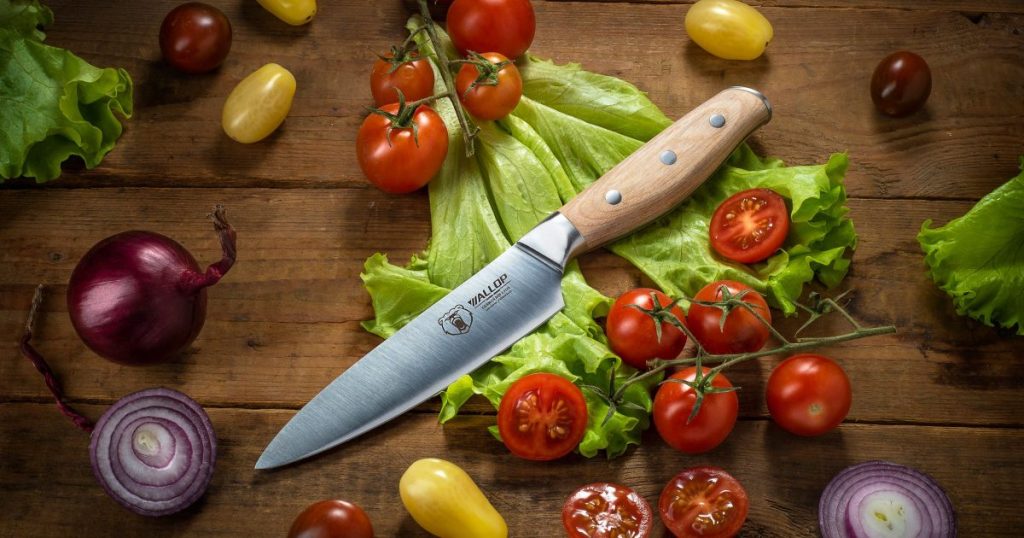
Most home cooks need three knives: an 8-inch chef knife for general prep, a serrated bread knife, and a small paring knife. Add a boning, carving, nakiri, cleaver, or utility knife only when a recurring task justifies it. A focused trio is easier to maintain and usually performs better than a large low-cost block.
Build a practical kitchen knife kit
| Need | Best tool | Why it earns a place | Tradeoff |
|---|---|---|---|
| Most chopping, slicing, and mincing | 8-inch chef knife | Board clearance, length, and a broad blade in one tool | Can feel large in a compact kitchen |
| Bread, ripe tomatoes, and cakes | Serrated bread knife | Teeth start cuts through crust or delicate skin without crushing | Awkward to sharpen at home |
| Peeling and close hand work | 3–4-inch paring knife | Control for trimming, hulling, and small produce | Too short for board-heavy prep |
| Meat trimming or fish work | Boning or fillet knife | Narrow profile reaches around bones and connective tissue | Flex and shape should match the task |
| Large cooked roasts | Slicing or carving knife | Long, narrow blade makes cleaner strokes | Low value if used only once or twice a year |
How to use this guide
Start with the food you prepare every week, not the number of slots in a block. Note which jobs your chef knife handles comfortably and where it genuinely struggles. Compare blade profile, usable edge length, handle security, cleaning, storage, and sharpening access. Country labels and dramatic hardness numbers are secondary to geometry, heat treatment, consistency, and fit.
Start with the chef knife
A chef knife should cover onions, herbs, vegetables, and boneless proteins without forcing your wrist into an awkward angle. Eight inches is the versatile default, but a six- or seven-inch model can suit smaller hands and boards. A ten-inch blade offers more cutting length but needs space and confident technique.
A curved German-style belly supports rocking cuts. A flatter Japanese-influenced profile favors push cutting and clean board contact. Neither is universally better. Choose the motion you already use, and check that the heel clears your knuckles.
Add a serrated knife and paring knife
A serrated knife is not only for bread. It starts cleanly through crusty loaves, soft cakes, citrus, and tomatoes without demanding a highly polished plain edge. Look for enough length to cross your usual loaf in one stroke and a handle that keeps knuckles away from the board.
A paring knife is for controlled small work, not a miniature replacement for every board task. A simple straight edge is easier to sharpen than decorative micro-serrations. Replace or sharpen it when extra pressure begins to make close hand work unsafe.
Understand steel without chasing a number
Stainless steel resists corrosion but is not stain-proof. Carbon steel can sharpen readily and develop a patina, yet it requires prompt cleaning and drying. Hardness can support a thinner, longer-lasting edge, but an overly acute hard edge may chip when twisted or struck. Softer, tougher steel often rolls instead and is easier to restore.
The maker’s heat treatment and the thickness behind the edge strongly influence performance. Treat unsupported claims such as “surgical steel” or an extreme hardness figure cautiously when the exact alloy, warranty, and maintenance advice are absent.
Choose handles and bolsters for your grip
A safe handle lets you control the blade without squeezing. With a pinch grip, check the spine and bolster area for sharp corners. With a handle grip, confirm that the shape does not force fingers together or become slippery when damp. Full tang construction can add confidence and balance, but tang length alone does not guarantee a durable knife.
A full bolster protects fingers and creates a traditional balance, while a short or absent bolster makes the heel easier to sharpen. Rivets should be flush, seams should not trap debris, and wood handles need more care than molded synthetics.
Buy storage and maintenance with the knife
A sharp knife stored loose in a drawer quickly becomes a dull and dangerous knife. Use a fitted sheath, drawer insert, stable block, or securely mounted magnetic strip. Avoid glass, stone, and ceramic cutting surfaces; wood and forgiving synthetic boards are kinder to the edge.
Hand-wash and dry immediately. Hone compatible edges when they lose alignment, and sharpen when honing no longer restores clean cutting. A few well-maintained knives are safer and more useful than a crowded set of blunt blades.
Safety and realistic limits
Cut on a stable board with a damp towel or non-slip mat beneath it. Curl the fingertips of the guiding hand, keep the cutting path clear, and never try to catch a falling knife. Use a bench scraper rather than the sharp edge to move chopped food.
Chef knives are not designed for bones, frozen food, cans, prying, or screwdriving. Use a dedicated tool for those tasks. If a knife arrives damaged, loose, badly warped, or with a faulty handle, stop using it and contact the seller or maker.
Useful reviews to compare
These product-specific pages help you apply the criteria above. They may contain affiliate links, while this guide itself links only to editorial pages.
- Amazon Basics Classic Knife Review
- Zwilling J.A. Henckels ZWILLING Chef’s Knife Review
- Kuhn Rikon Straight Paring Knife Review
- BOLEXINO 6 Inch Boning Knife Review
- Amazon Basics 14-Piece Knife Set Review
Continue learning
Browse Kitchen Knives or continue with our chef knife guide, the pocket and EDC guide, the outdoor knife guide, the sharpening and care guide, and the specialty knife guide.
Frequently asked questions
Is a knife block set good value?
It can be when you will use most pieces and the block allows safe storage. Many sets inflate the count with steak knives or redundant blade shapes, so compare the cost and quality of the three or four tools you actually need.
Do I need a santoku and a chef knife?
Usually not at first. Their roles overlap. Choose the profile and length that fits your cutting motion, then add the other only if its flatter edge, shorter size, or food-release features solve a recurring problem.
Can kitchen knives go in the dishwasher?
Hand-washing is safer. Dishwasher heat, chemicals, moisture, and contact with other objects can dull the edge and damage the handle or finish.
What should I spend first?
Put the largest share into the knife you use most, then into safe storage and a suitable cutting board. A modest knife kept sharp usually outperforms an expensive neglected one.
Sources and review standard
- Victorinox: how to choose the right kitchen knife
- ZWILLING knife guide
- ZWILLING sharpening and care guidance
Featured image: Photo by Evgeniy Alekseyev via Pexels, used under the Pexels License. Specifications and availability should always be rechecked on the exact product page before purchase.