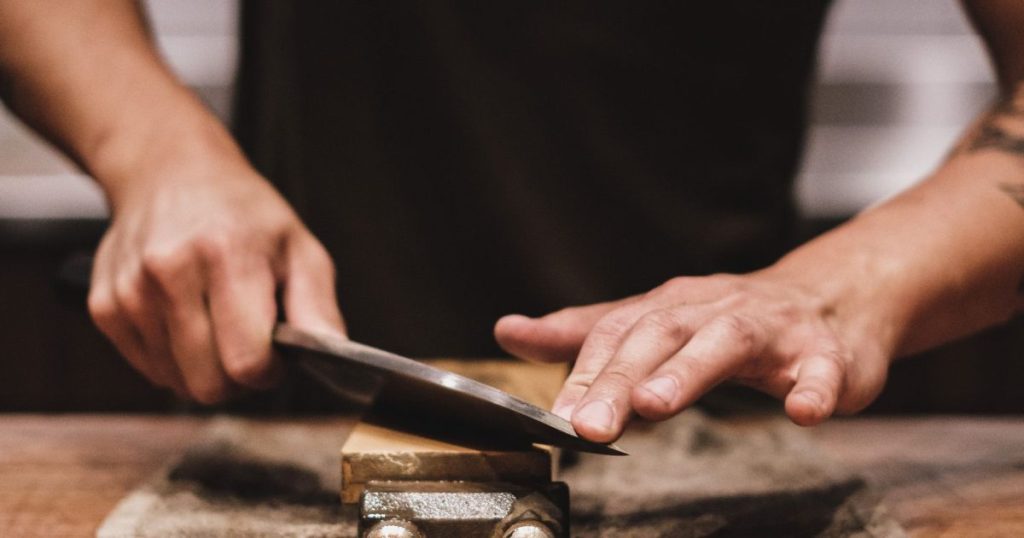
Hone a knife when the edge has lost alignment but still has usable geometry; sharpen it when honing no longer restores clean cutting. Use an angle and abrasive suitable for the steel, raise and remove a burr deliberately, and stop before unnecessary metal removal. Hand-wash, dry promptly, use a forgiving cutting board, and store the edge so it cannot strike other tools.
Select the right maintenance action
| Symptom | Action | Suitable tool | Common mistake |
|---|---|---|---|
| Slight loss of bite; no chips | Hone or lightly strop | Compatible rod or strop | Using excessive pressure |
| Honing no longer helps | Sharpen | Stone, guided system, or professional service | Changing angle on every stroke |
| Small chips or thick shoulders | Repair and reprofile | Coarser abrasive or professional service | Grinding only the very edge |
| Rust spots or food residue | Clean and treat promptly | Non-abrasive cleaner; maker-approved method | Soaking or using chlorine cleaner |
| Loose handle, lock issue, or crack | Stop use and repair/replace | Manufacturer or qualified repairer | Trying to sharpen around a structural fault |
How to use this guide
Inspect the blade under bright light. A rolled edge may reflect intermittently and respond to gentle honing. A rounded, worn bevel needs sharpening; chips and severe asymmetry may need repair. Identify the steel and maker-recommended angle, choose a stable abrasive, secure the work area, and plan how you will verify progress without running a finger along the edge.
Honing is not the same as sharpening
Honing primarily straightens or refines the apex and removes little metal when done gently. It can restore a working edge quickly on many Western kitchen knives. Sharpening abrades steel to recreate the bevels and apex. A rod cannot indefinitely rescue an edge whose geometry is worn or damaged.
Use a rod at least as long as the blade and stable enough to control. Place its tip on a non-slip surface, hold the knife at the intended angle, and make slow heel-to-tip passes with light pressure. Very hard, thin, or brittle edges may require fine ceramic, stropping, or stones rather than a grooved steel.
Choose an angle based on the knife
Lower angles reduce cutting resistance but leave less material supporting the apex. Higher angles sacrifice some slicing ease for durability. Many Western kitchen edges are maintained around 15 degrees per side, while some Japanese makers specify more acute ranges; outdoor and utility tools may require stronger geometry.
Do not copy a generic number over the maker’s instructions. Existing bevels can be observed with marker ink: color the bevel, make a light pass, and check where abrasive was removed. Consistency is more important than chasing a mathematically perfect angle.
Use whetstones with a repeatable process
Choose a stable stone and follow its water, soaking, or oil requirements. Start coarse only when the edge is damaged or needs major shaping. For routine sharpening, a medium stone can recreate the apex and a finer stone can refine it. Move through grits only after the first stone has done its job.
Work one side until a small continuous burr forms, then repeat on the other side. Reduce pressure, alternate strokes, and remove the burr. A burr is evidence that bevels met, not a feature to leave behind. Clean the blade and stone before testing on food.
Guided systems, pull-through tools, and services
Guided systems help repeat an angle and suit owners who want predictable results, but clamps and stones must fit the blade. Manual pull-through sharpeners are quick, yet fixed aggressive wheels can remove excess material, scratch finishes, and poorly accommodate unusual angles or thick bolsters.
Electric systems can be effective when their stages match the knife. For valuable, single-bevel, heavily chipped, or unfamiliar blades, a reputable sharpening service is often cheaper than correcting an inexperienced repair. Ask how the service controls heat and preserves geometry.
Daily care protects the edge
Use wood or a forgiving synthetic cutting board. Glass, stone, and ceramic surfaces roll or abrade an edge rapidly. Hand-wash with mild soap, keep the sharp edge away from the sink bottom, and dry immediately. Carbon steel may need a thin food-safe protective film during storage.
Store knives in fitted sheaths, a drawer insert, a stable block, or on a properly installed magnetic strip. Clean and dry the blade before storage. Do not crowd sheaths that trap moisture or let exposed edges collide in a drawer.
Sharpening safety and troubleshooting
Stabilize stones with a holder or damp towel, keep fingertips above the bevel, and direct strokes away from vulnerable body parts. Work slowly with adequate light. Never test sharpness by sliding a thumb along the edge; use controlled paper or food tests and stop if the setup moves.
If one side develops a burr but the other does not, angle or pressure may be inconsistent. If the heel remains dull, a full bolster may block the abrasive. If the knife chips repeatedly, the edge may be too acute for the use, the board may be too hard, or the blade may require professional inspection.
Useful reviews to compare
Apply the criteria above to these product-specific reviews. They may contain affiliate links; this guide links only to editorial pages.
- JCHOPE Knife Sharpener Review: Restoring Blades
- FUVUEAZ Knife Sharpeners Review
- Kitchen Pocket Knife Sharpeners Review
- Knife Sharpener Review
- XL Knife Block Review
- Walnut Magnetic Knife Holder Review
Continue learning
Browse Knife Care & Storage and compare the kitchen knife guide, the chef knife guide, the pocket and EDC guide, the outdoor guide, the sharpening guide, and the specialty guide.
Frequently asked questions
How often should I sharpen a kitchen knife?
Sharpen based on performance, not a fixed calendar. Frequency depends on steel, geometry, board, technique, use, and honing. Sharpen when appropriate honing no longer restores clean cutting.
Should I soak every whetstone?
No. Some stones require soaking, some need only surface water, and oil stones use oil. Follow the exact maker instructions because soaking the wrong stone can damage it.
Can I sharpen serrated knives?
Yes, but each scallop normally requires an appropriately sized tapered abrasive and careful work from the beveled side. A professional service is sensible for expensive or fine serrations.
Does a honing rod make a knife sharper?
It can restore cutting ability by realigning or refining the apex, but it does not replace the metal-removal needed when bevels are rounded, thick, or damaged.
Sources and review standard
Featured image: Photo by Airam Dato-on via Pexels, used under the Pexels License. Specifications and availability should always be rechecked on the exact product page before purchase.